On Negotiating: Notes From a Recovering People-Pleaser
Why negotiation felt impossible for me, and the simple shift that made it learnable.
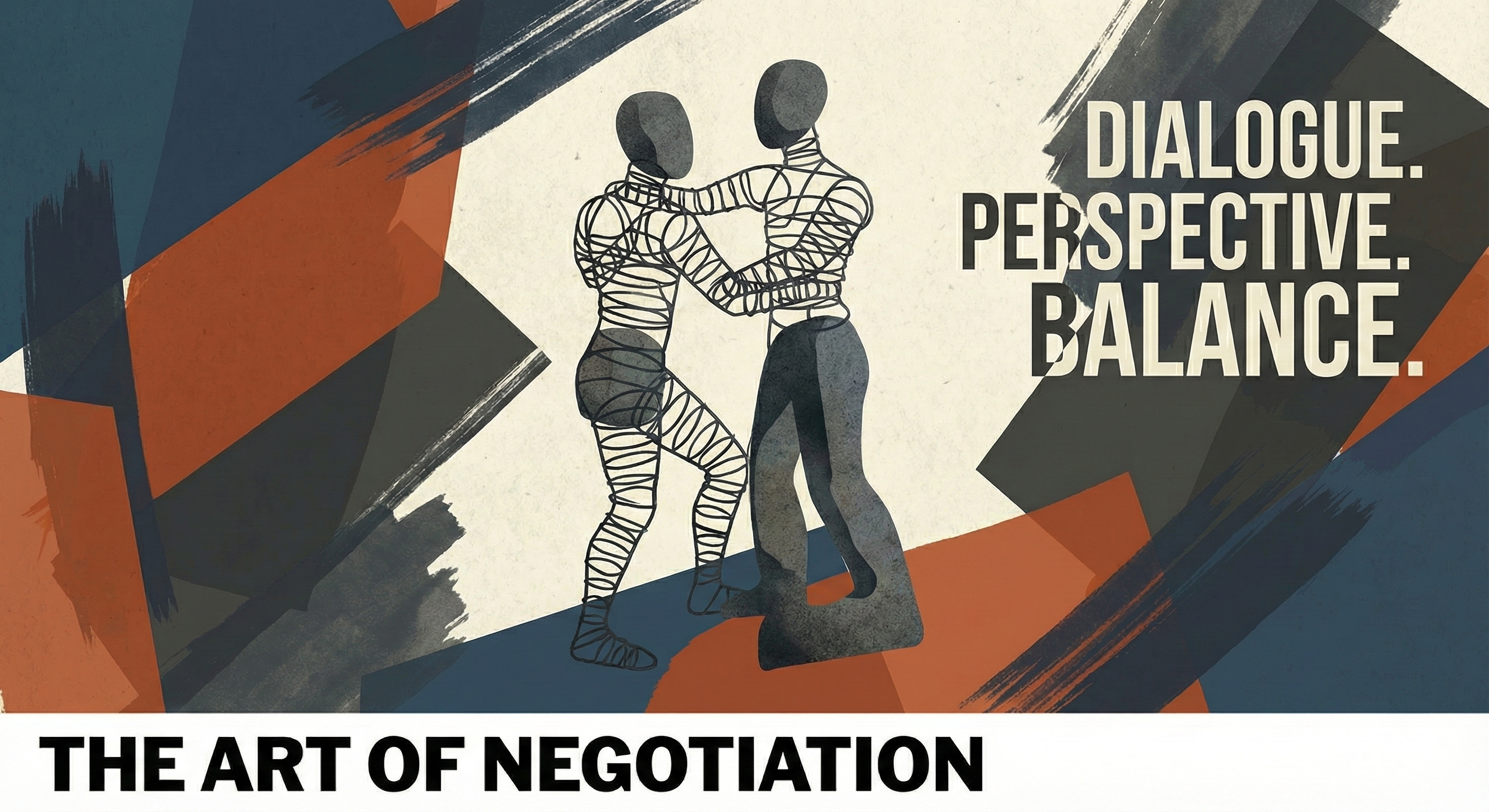
Negotiation is one of those skills that some people seem to have been born with.
You know the type. They ask for things effortlessly. They push back without anxiety. They walk out of conversations with better outcomes, not because they're aggressive, but because they're comfortable advocating for themselves.
I am not that type.
For most of my life, I've been the other kind — the one who says yes when I mean no, who empathizes so hard with the other side that I forget to represent my own, who leaves conversations wondering why I agreed to things I didn't actually want.
It's not shyness exactly. It's more like my default wiring is set to "keep the peace" at all costs — even when the cost is my own interests.
The realization that changed things
Here's what I eventually figured out: negotiation isn't a personality trait. It's a skill. Which means you can learn it.
This sounds obvious, but it wasn't to me. I genuinely thought some people were just "good at this stuff" and I wasn't. That framing kept me stuck for years.
What shifted was encountering enough situations — at work, with friends, in life — where I had to negotiate, whether I wanted to or not. Salary conversations. Lease renewals. Project scope disagreements. Boundary-setting with people I cared about.
Through trial and a lot of error, I started to see patterns. Not tricks or tactics, but a way of thinking about negotiation that made it feel less like combat and more like problem-solving.
The framework: heart first, then head
Here's what works for me. It's simple, but I find myself returning to it every time things get complicated.
Step 1: Figure out what you actually want.
Before any tactics, before thinking about the other person, before strategizing — stop and ask: what do I actually want here?
This sounds obvious. It isn't. I've walked into conversations where my "position" was really just a reaction to the other person's position, or a version of what I thought I should want, or some compromise I'd already made in my head before the conversation even started.
The first step is clarity about your own interests. What outcome would actually serve you? Not what's "reasonable" or "fair" — what do you want?
This is the "follow your heart" part.
Step 2: Map the landscape.
Once you know what you want, now you can use your head. Think about:
- What does the other person want? (Not their position, but their underlying interests.)
- What are the possible outcomes? Win-win, win-lose, lose-lose — play them out in your head.
- Where is there room for creative solutions? Can the pie be made bigger?
This is game theory, basically. Not adversarial, just clear-eyed about the situation.
Step 3: Use a structure for the actual conversation.
For this part, I've found the Harvard Negotiation framework genuinely helpful. It's from the book Getting to Yes, and there's a good short video that summarizes it:
The core ideas:
-
Separate the person from the problem. It's not you vs. them. It's both of you vs. the issue. The moment it becomes personal, everyone gets defensive and the conversation goes sideways. Treat them as a partner in solving the problem, not an enemy to defeat.
-
Focus on interests, not positions. Positions are what people say they want. Interests are why they want it. Most conflicts happen at the position level, but solutions happen at the interest level. Ask: what's driving their position? What would actually satisfy them?
-
Establish criteria before solutions. Before brainstorming answers, agree on what a good solution would look like. What needs to be true for both of you to feel satisfied? This creates a shared frame that makes evaluation easier.
-
Generate multiple options. Don't propose one solution — propose several. It gives both parties a sense of choice, creates room for genuine agreement, and avoids the "take it or leave it" dynamic that kills negotiations.
When to use this (and when not to)
This framework is most useful when the situation is fuzzy — when you're not sure what you want, or the other person's interests aren't clear, or you're dealing with something complex.
But sometimes, you already know the answer. It's a clear no. Or a clear yes. Or there's a boundary that isn't up for negotiation.
In those cases, don't overthink it. Just say it. The framework is for ambiguity; it's not a substitute for knowing your own mind.
If you're like me — if negotiation feels unnatural, if you tend to over-accommodate, if the phrase "advocating for yourself" makes you slightly uncomfortable — I want you to know: this is learnable.
It doesn't require becoming a different person. It just requires getting clearer on what you actually want, and then being willing to say it out loud.
That's the whole skill. Everything else is refinement.