The Emotional Vocabulary I Never Learned
On communication as a spectrum — and why some of us grew up with only two settings.
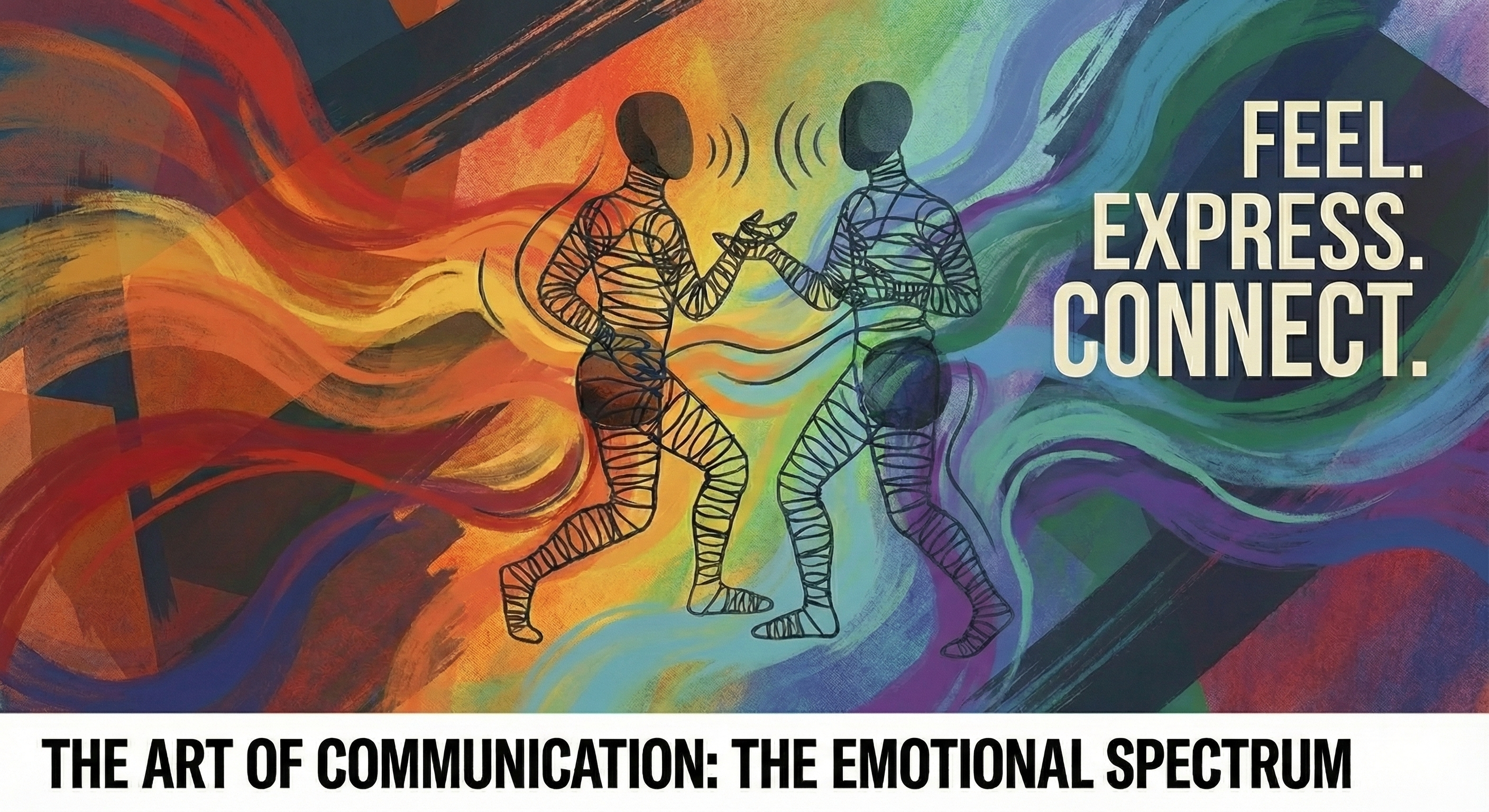
Here's something embarrassing I realized about myself in my mid-twenties: I only knew how to communicate in two modes.
Happy. Or angry.
That's it. Two settings. Like a thermostat that could only do "off" or "full blast."
If I was pleased, I'd show it — sometimes too much, in ways that felt performative even to me. And if I was frustrated or hurt, the only tool I had was anger. Not the cold, precise kind that clarifies. The hot, messy kind that escalates everything.
For a long time, I thought this was just my personality. I'm just expressive. I wear my heart on my sleeve. That kind of thing.
But that wasn't quite right. It wasn't that I felt things strongly — it was that I didn't know how to express the in-between.
The spectrum I didn't know existed
Communication isn't binary. There's a whole range between "neutral" and "angry" that I never learned to use:
- Disappointment that stays calm
- Disagreement that stays respectful
- Firmness that doesn't become aggression
- Boundaries that don't require conflict
And on the positive side:
- Appreciation that feels genuine, not performative
- Enthusiasm that doesn't overwhelm the room
- Warmth that doesn't need to prove itself
- Quiet satisfaction that doesn't demand acknowledgment
These aren't just emotions — they're skills. Ways of modulating what you're feeling so it lands correctly with another person.
I didn't have these skills. My emotional vocabulary was a crayon box with two colors.
Where the pattern came from
When I look back, the source is obvious: I learned communication the way everyone does — by watching the people around me.
And the people around me weren't great at this either.
My parents, in particular, communicated with a lot of emotional weight. Every conversation carried something — approval or disappointment, warmth or frustration. The information was always tangled up with the feeling. It was hard to know what was actually being said versus what was being felt.
I absorbed this without realizing it. I learned that communication = emotion. That expressing something means feeling something, visibly and loudly.
What I didn't learn was how to separate the two. How to deliver a message with precision, with the right intensity for the situation, without the emotional noise that distorts it.
The gap I'm trying to close
Here's the practical problem: a lot of important communication requires nuance that I historically didn't have access to.
Expressing dissatisfaction without aggression. Sometimes you need someone to know you're unhappy — a colleague, a partner, a friend — without turning it into a fight. This requires disappointing someone clearly but calmly. For me, this used to feel impossible. If I was unhappy, it leaked out as irritation. Or I suppressed it entirely and said nothing, which built resentment.
Being firm without being hostile. Boundaries require a specific register: clear and non-negotiable, but not adversarial. I didn't have this setting. My "firm" always tipped into "aggressive," which made people defensive, which made everything harder.
Showing care without performing it. On the positive end, I've noticed that my warmth sometimes comes across as over-the-top. Like I'm trying too hard. This is because I only have one way to show I care: full intensity. I'm trying to learn the quieter versions — presence, attention, small consistent signals.
The core pattern: I was missing the middle registers. I could whisper or shout, but not speak.
What I'm practicing
I don't think you can just decide to be a better communicator. You have to actually practice new patterns until they become available to you. Here's what I've been working on:
Pausing before reacting. When I feel something strongly, my old habit is to express it immediately. Now I try to pause — not to suppress, but to ask: what am I actually trying to communicate here? What's the right intensity for this?
Naming the actual emotion. Instead of defaulting to anger (which is often a cover for something else), I try to find the more specific word. Am I disappointed? Hurt? Confused? Worried? The more precise I can be with myself, the more precise I can be with others.
Watching people who do this well. I've started noticing how skilled communicators handle difficult moments. The ones who can be direct without being harsh. Who can express warmth without being overwhelming. I'm trying to learn by observation — which is how I learned the broken patterns in the first place.
Practicing the quiet registers. Small moments where I resist the urge to over-express. Saying "that meant a lot to me" instead of a dramatic show of gratitude. Saying "I'm not comfortable with that" instead of exploding or going silent.
Why this matters
Communication isn't just about being understood. It's about being understood correctly.
If I'm upset about something small and I deliver it with the intensity of something big, the other person responds to the intensity, not the issue. The message gets lost.
If I'm grateful for something meaningful and I express it the same way I express casual thanks, it doesn't land. The moment passes without weight.
The spectrum exists for a reason. Different situations require different registers. And if you only have two colors, you can't paint most of the picture.
I'm still working on this. Some days I catch myself mid-escalation and manage to downshift. Other days I don't catch it at all.
But I've stopped believing this is just "how I am." It's how I was trained. And training can be updated.
The emotional vocabulary is learnable. I'm learning it late, but I'm learning it.